

'Use Your Words' is the Right Goal. It Just Might be the Wrong Moment.
They want to. They really do. Here's why they can't and what to try instead.
Your toddler knows words. Probably a lot of them. They narrate their breakfast, they explain exactly which cup they want, they have strong opinions about which shoes go on first. The vocabulary is there.
So when they're melting down in the middle of the grocery store and you kneel down and say "use your words", it feels reasonable. You know they have words, they use them all day long. What's the problem?
The problem isn't vocabulary. It's neuroscience.
What's actually happening in their brain
When your child gets emotionally activated (frustrated, scared, overwhelmed, furious that the crackers broke) their brain shifts into a different operating mode. The part of the brain that handles threat detection and emotional response, essentially takes over (the amygdala). And when that happens, the part responsible for language, logic, reasoning, and self-control goes offline (the prefrontal cortex).
This isn't a choice. It's not defiance. It's not manipulation. It's developmental physiology.
“You’re not dealing with a child who won’t use their words. You’re dealing with a child who temporarily can’t because the part of their brain that accesses language is no longer in charge.”
The thing that makes this especially hard for toddlers is that their prefrontal cortex won't be fully developed until their mid-twenties. Right now, they are running adult-sized emotions through a brain that doesn't yet have the wiring to manage them. The intensity of what they're feeling is real. Their capacity to handle it is physiologically limited.
So when they're in that activated state and you ask them to use words, you're asking the part of the brain that's currently offline to come back and take the wheel. It doesn't work. And when it doesn't work, everyone gets more frustrated, and the storm gets bigger.
Why we keep saying it anyway
Because it feels like the right move. We want them to communicate. We want to understand what they need. We know they have language, and we're trying to access it. The instinct isn't wrong. The timing is.
"Use your words" is the right destination. It's just not something you can demand at the peak of a meltdown. Asking for language when the emotional brain is running the show is like asking someone to solve a math problem while they're actively panicking. The capacity isn't available in that moment.
The approach doesn't change! Words are still the goal, but the sequence has to change first.
There is a window where "use your words" is still appropriate and effective. When you can see your child starting to get frustrated but they haven't crossed into full activation yet, that's the moment. They may be starting to whine, making frustrated sounds, etc. The language centers are still online. The invitation makes sense. It's specifically at the peak of a meltdown, once the storm is fully underway, that the request stops working, and can make things worse.
Find calm first. Everything else comes after.
Before language, before problem-solving, before any of the good stuff, there has to be calm. Not perfect calm. Just enough regulation that the prefrontal cortex can start coming back online.
The part that surprises most parents is…your calm IS the intervention. It's not passive waiting. It's doing something. Their nervous system looks to yours to borrow stability. When you stay regulated you are actively helping their brain downshift, even when it's hard, even when you're tired and you're in public and you have nowhere to be but here.
“Children co-regulate before they self-regulate.”
THE SHIFT IN PRACTICE
Instead of asking for words during the storm, your job in that moment is to be the calm. Get low. Soften your voice. Sometimes say nothing at all. Just be a steady, present anchor until the wave passes.
You cannot reason with a dysregulated brain. But you can outlast the moment with them. That's what gets you to the words.
Then name the feeling before you ask them to
Once you see the wave starting to pass, that's when language becomes available again. You’ll notice the breathing slowing, the body softening, and the storm getting quieter. The best way to get there isn't to ask "what's wrong?" or "can you tell me how you feel?"
It's to do it for them first.
Name what you observed. Not what you think they should feel, and not a question, a statement. You saw it. You say it.
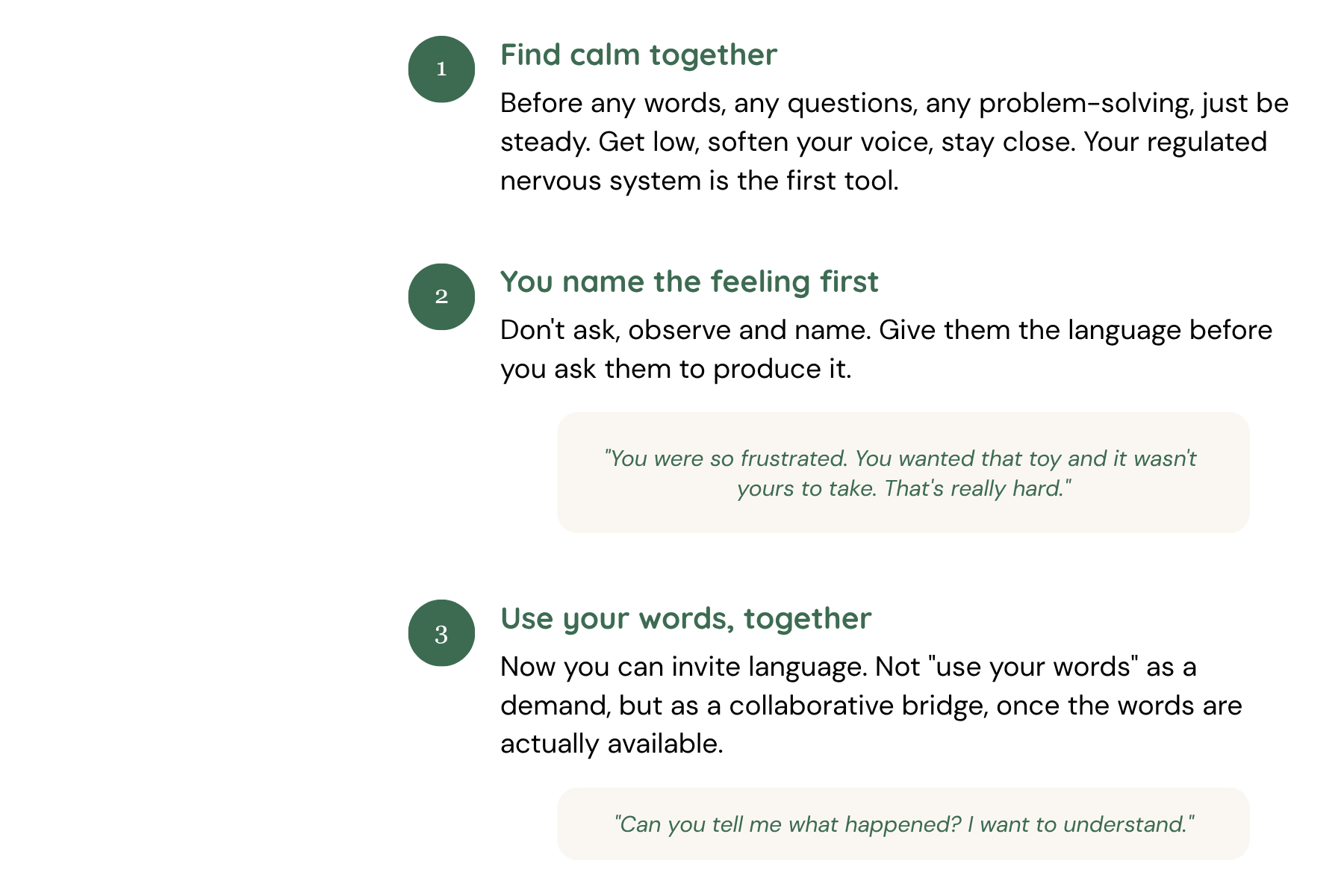
This sequence (calm, name, words) builds something over time. Every time you name a feeling accurately at the right moment, you're depositing into an emotional vocabulary your child will eventually be able to access on their own. You're not just surviving the meltdown. You're building the skill.
What this looks like when you unsee the old way
The next time you're in the thick of it…and there will be a next time, probably before the end of the week or the end of today…you'll notice yourself starting to reach for "use your words." That's the old pattern trying to run. You don't have to judge it. Just notice it, and redirect.
Instead: get low, get quiet, get regulated. Wait for the storm to pass. Name what you saw. Then invite the words.
It won't always be clean. Some days you'll get there too late, or say the wrong thing, or lose your own calm first, and that's fine, everyone here is learning. The goal isn't a perfect response every time. The goal is a pattern that shifts over months, not minutes.
But once you understand why the old approach was working against you, it's hard to unsee. And that's where the change actually starts.
KINDER WEATHER™
If you want to go deeper on this...
This is exactly what I teach in Kinder Weather, the ability to read what your child is actually experiencing in real time, name it with them in language they can absorb, and help them choose what to do next. It's a whole framework I built around the idea that understanding comes before behavior change. If this landed for you, Kinder Weather is where the tools live.
Your child isn't being difficult when the words disappear. They're being human; a very small, still-developing human with more feeling than their brain currently knows what to do with.
Find calm first. Name it for them. Then use your words, together. 🩶
KINDER WORKSHOPS · TACOMA, WA
Want to practice this in real life?
Kinder Weather™ is a small-group workshop where we go through the whole framework together, the science, the strategies, and the language to use in the moment.
